“Much of the power of the novel resides in the fact that Ellyn refrains from attempting to explain eating disorders, focusing instead on vivid descriptions of what it feels like to actually have one. There are breezy episodes in the book that are light and funny, but the reader never loses sight of the brutality of the disease at the heart of the story, and passages of the book are deeply disturbing. Ellyn has a dry sense of humor and an impeccable eye for detail that allow her to evoke the dark chambers of her own mind with poetry and compassion, and she handles language gracefully and with a peculiar lyricism that’s uniquely hers.”
Synopsis
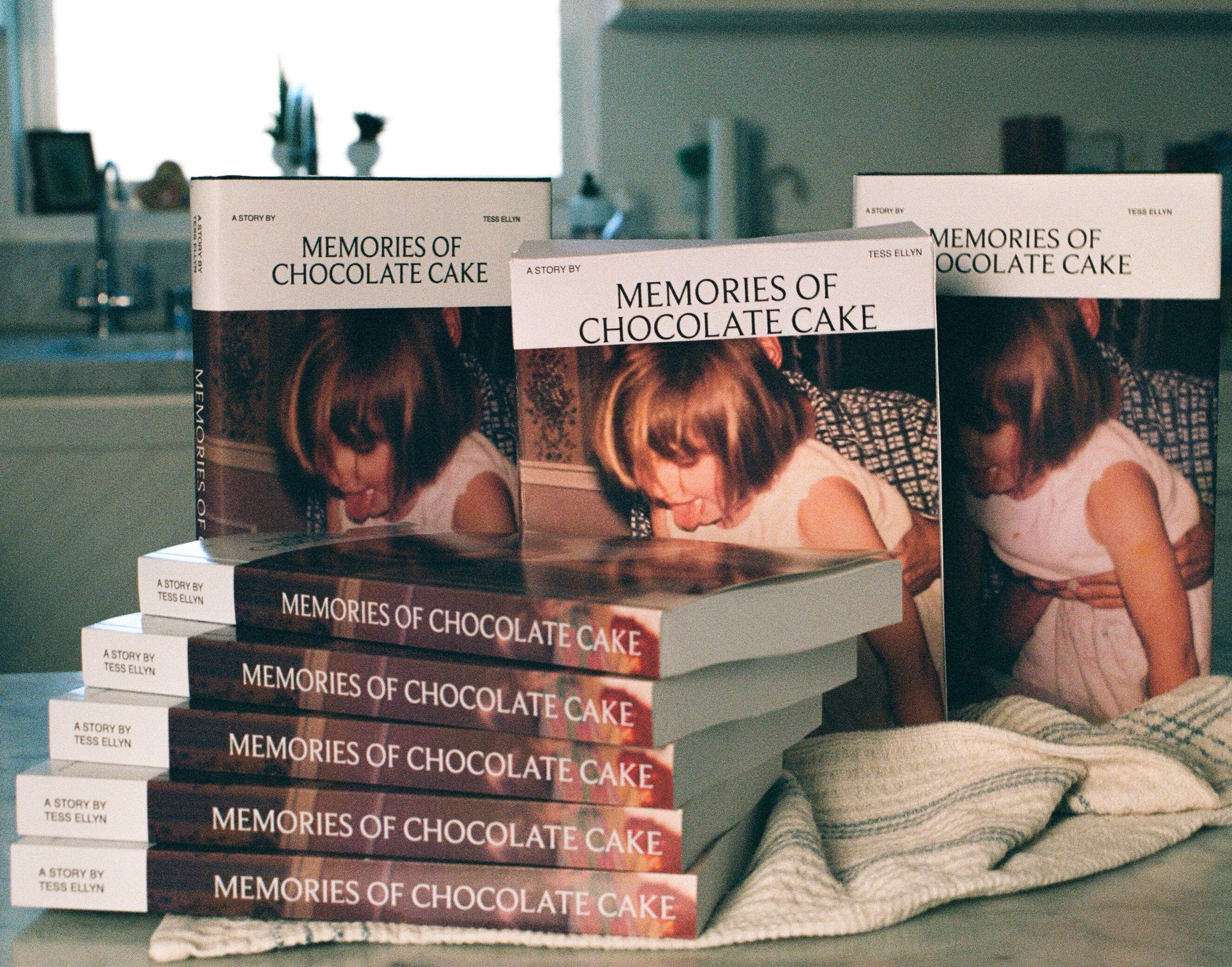
Memories of Chocolate Cake is an intimate memoir by Tess Ellyn that explores the complexities of recovery and asks a deeper question: what is really being starved when one restricts?
At 22, Tess arrives in Paris to study at the famed Le Cordon Bleu, hoping to outrun the shadow of illness that’s followed her since she was 15. She’s chasing a dream—though she’s not entirely sure what that dream is. What she finds isn’t redemption exactly, but something more honest: a slow reckoning with a body, a city, and the myths built around both.
Memories of Chocolate Cake traces one young woman’s coming-of-age through illness, ambition, love, and self-discovery—with moments that are painful, uplifting, and, at times, unexpectedly funny.
“A story that explores the fragile strength within all of us”
A message from your daughter,
If you had met me prior to today, you likely know at least two of three facts: that I have had an eating disorder, that I was writing a book, and that I have always been single—three facts that appear independent of one another and yet, are inseparable as I have found they are bound together by the same unanswered questions about desire and discipline, and about what it means to wait for one’s life to begin.
Had you told me when I was six or seven that I would be hospitalized at fifteen for anorexia, that the next fifteen years would be shaped by a book I could neither finish nor abandon, and that I would remain single throughout it, I would not have believed you—not because the events themselves were unimaginable, but because they contradicted the story I was already telling myself. I liked food. I earned good grades. I was special.
What followed instead was a long education in contradiction: years in which English teachers—from third grade through my third year at King’s—returned my papers with concern rather than confidence, pointing out failures of spelling, grammar, comprehension, the basic mechanics of grasping a text; years in which I continued to believe, despite evidence to the contrary, that validation would arrive from outside myself, that someone—a partner, an agent, an opportunity would appear and confirm what I could not yet confirm on my own.
That didn’t happen.
What arrived instead was an eating disorder, and then a book, and then the gradual realization that neither was incidental: that the disorder was a way of controlling what could be controlled when other forms of certainty failed, and that the book was an attempt to make sense of the waiting, and to impose narrative on a life that felt stalled and unresolved.
I have only allowed myself to identify as a writer in the last year. It was difficult to look in the mirror and make a positive claim to the very thing I had been projecting for so long, because the way I write is inseparable from who I am. So, to assert authorship felt dangerously close to self-belief.
I understand now that no one will ever care about this book as much as I have, which is precisely why I chose to self-publish: to stand up and validate it in the way I once imagined another would, which ironically, contradicts the belittling nature that had governed so many of my decisions. The writing in this book is good. The story is interesting. But it’s the character. The flawed, imperfect girl, who is entirely recognizable that makes her someone to be very proud of.
I hope that in reading my story, you recognize something of yourself. It isn’t a special story—it’s a common one. The difference is that I took the time to tell it, and to say: I’m done.
This book, then, immortalizes a particular period of my life: the years in which illness and ambition mirrored one another; the way restraint masqueraded as discipline; the belief that meaning would arrive later and in full, as compensation for endurance. But what it ultimately records is something quieter and harder won—the long, messy, and necessary process of realizing that the only validation I was waiting for was my own. The very thing my dad addressed to me in his letter…
I publish this book in order to keep the meaning exposed, if only long enough for me to realize my life never started, like all of yours, because it never stopped. So, thank you for giving me a chance & taking the time to read it.
x
What people are saying…
“This book is incredibly vulnerable, honest, and deeply relatable. The author truly captures what it feels like to grow up as a teenage girl and carry that awkwardness, self-doubt, and longing for belonging well into your 20s. The writing is so intimate and open that you feel like you truly know her by the end, as if she’s trusted you with her story. It’s raw without being sensational and compassionate without glossing over the hard parts. An amazing, brave book that stays with you long after you finish it.”
-Brianne (Amazon Review)
“What resonated most deeply with me is how Tess’s illness did not define her in the end. She emerges not as fragile or broken, but as someone who has discovered a deep, hard-earned appreciation for life. Her decision to step into the world of French cuisine—to study at Le Cordon Bleu, of all places—is such a moving symbol of her transformation. Food, once a battleground, becomes her art, her joy, and her expression of healing. That reclamation feels both poetic and profoundly human.”
- Mo (Amazon Review)“Memories of Chocolate Cake is a vivid and compelling story of struggle and growth. Tess’s story is unique, but offers meaning to anyone who has struggled with how emotions shape our reality. The book leaves me thinking about the nature of human will. Will power gives us agency over our lives, and propels us toward meaning and purpose. But will power can also turn against us — and not just for people with anorexia. Strong will can lead us down dark paths, but also back toward light. Strong will can distort reality but also give us the courage to face it. Tess Ellyn’s first book is a lively and enjoyable read with a serious message of interest to a wide variety of readers.”
- Anonymous (Amazon Review)